SMART goals for fitness: 10 examples and how to write one with a client
SMART goals for fitness are specific, measurable, achievable, relevant and time-bound. See ten worked examples and a simple way to turn a vague client goal into one.

SMART goals for fitness are goals that are Specific, Measurable, Achievable, Relevant and Time-bound. To write one with a client, name the exact outcome, pick one number you can track, check it fits their current level and life, tie it to why they came to you, and set a date to review it. Ten smart fitness goals examples follow, plus a script for turning "I want to get toned" into a goal you can coach.
Below: what each letter means in practice, a conversation template, ten worked examples across strength, fat loss, endurance and habits, and the mistakes that make goals fail.
What does SMART stand for in fitness goals?
SMART is a goal-writing checklist: Specific, Measurable, Achievable, Relevant, Time-bound. Each letter removes one kind of vagueness.
| Letter | The question to ask | Weak version | Stronger version |
|---|---|---|---|
| Specific | What exactly will change? | "Get stronger" | "Squat a heavier weight for 5 reps" |
| Measurable | Which number will show it? | "Look better" | "Waist measurement goes down" |
| Achievable | Is it realistic for this person now? | "Run a marathon next month" | "Run 5 km without stopping" |
| Relevant | Does it matter to them? | "Do 20 pull-ups" (for a client who wants energy) | "Walk daily, train 3 times a week" |
| Time-bound | By when do we review it? | "Someday" | "By the end of week 12" |
A goal that fails one letter usually fails in a predictable way. No number means no feedback. No date means no urgency. No link to the client's reasons means they stop caring by week three.
How do you turn a vague goal into a SMART goal?
Ask five questions in order, and write the answers into one sentence. This works in a consultation or a first check-in.
- What would be different if this worked? "I want to feel fitter" becomes "I can climb the stairs at work without stopping."
- How would we know? Choose one number: a lift, a time, a measurement, a count of days.
- Where are you today? Get a baseline from a test, an intake form or the first check-in. Without it, you cannot judge if the target is achievable.
- How much time and energy do you really have? Count sessions per week the client can keep, not the ones they hope for.
- When do we look at it again? Set a review date, and a smaller checkpoint halfway.
Then read it back: "By [date], you will [measurable outcome], training [frequency], starting from [baseline]." If the client winces, the target is probably not achievable or not relevant. Adjust it now rather than at the first missed week.
Get the baseline before the target
A target set before a baseline is a guess. Collect starting numbers through a client intake form and a first set of measurements; the guide on how to take body measurements covers consistent technique. Our client intake questions post lists what to ask.
What are some SMART fitness goals examples?
The examples below are illustrative: the numbers are made up to show the structure, not targets to copy. Every real goal depends on the client's history, health and schedule. Clients with injuries, pain, pregnancy, eating disorders or medical conditions should see a doctor or registered dietitian before you set body or performance targets.
Example: strength goals
- Squat. "Within 12 weeks, squat 5 reps at a weight 10 kg above today's 5-rep weight, training legs twice a week." Specific lift, measurable load, achievable as a small step, time-bound.
- Bench press. "By week 10, bench press our agreed bodyweight-based target for 3 clean sets of 5, with the same pause at the chest each time." The pause keeps the measure honest.
- First pull-up. "In 8 weeks, do one strict pull-up, starting from band-assisted sets three times a week." Relevant for a client who named pull-ups as their reason for joining.
For tracking strength, estimated one-rep max helps; the one-rep max calculator gives a starting figure, and progressive overload explains how to progress the load.
Example: fat loss and body composition goals
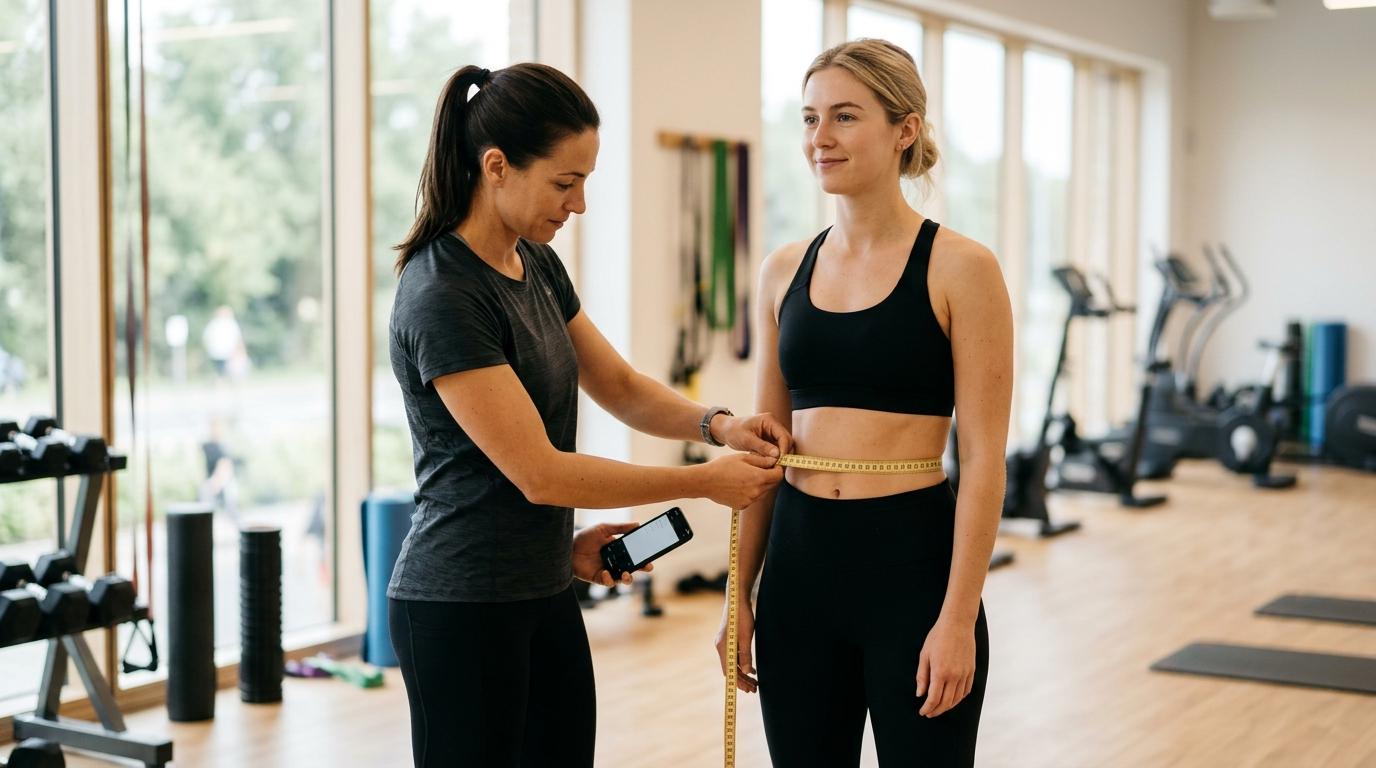
- Waist. "Reduce waist measurement by 4 cm over 12 weeks, measured every two weeks at the same point, while training three times a week." A circumference is less noisy than daily weight.
- Body weight with a range. "Lose between 3 and 5 kg by week 12, weighed each Monday morning, using the weekly average, not single days." A range and an average stop one bad weigh-in from derailing the plan.
- Food logging. "Log food on at least 5 days a week for the next 8 weeks." This is a process goal the client fully controls, and it gives you data to adjust their plan. The calorie deficit calculator can help frame energy targets, but refer clients with a history of disordered eating to a registered dietitian rather than setting numeric targets yourself.
Example: endurance goals
- First 5 km. "In 10 weeks, run 5 km without walking, building from three run-walk sessions a week." Baseline: what they can run today.
- Cardio capacity. "In 12 weeks, hold a conversational pace for 30 minutes on the bike at a heart rate we set from their zones." Use the heart rate zone calculator to set the range.
Example: habit goals
- Daily steps. "For the next 6 weeks, hit the agreed step target on at least 5 days a week, raising the target after week 3." Start from their current average, not an ideal.
- Sleep and water. "For 4 weeks, be in bed by the agreed time on 5 nights a week and tick off water every day." See habit tracking for how clients log these.
Notice the pattern: outcome goals (a lift, a waist number) sit alongside process goals (sessions, logging, habits). Process goals give clients wins in weeks when the outcome has not moved.
How do you check progress on a SMART goal?
Review a SMART goal on a fixed schedule: a quick weekly look at the process numbers, and a formal review at the halfway point and the end date. At each review, ask whether the goal should stay, grow or change.
A simple review routine
- Weekly: sessions done, habits ticked, food days logged. A weekly check-in captures these and lets you reply with context. Our weekly check-in questions give wording you can reuse.
- Every 2 to 4 weeks: measurements, a lift test or a timed run.
- At the halfway point: compare against the checkpoint. On track: keep going. Ahead: raise the target. Behind: look at adherence first, before blaming the plan.
- At the end date: record the result, then set the next goal while motivation is high.
If adherence was high and the outcome did not move, adjust training or nutrition. If adherence was low, ask what got in the way and fix that first.
What mistakes make SMART goals fail?
Most failures come from a few repeat errors.
- Too many goals at once. One main goal and up to two supporting habits is enough for most clients.
- Only outcome goals. Add process goals so progress is visible every week.
- Targets from the coach's head. The goal must be relevant to the client's own reasons, in their words.
- No baseline. You cannot call a target achievable if you do not know the start.
- Never revisiting. A goal written in week one and not reviewed is a wish. Put review dates in the calendar.
- Aesthetic targets without care. For clients who are anxious about weight or body shape, steer toward performance and habit goals, and refer to a doctor or registered dietitian where there are concerns.
FAQs
What is a SMART goal in fitness?
A SMART goal in fitness is a goal that is specific, measurable, achievable, relevant and time-bound. For example: "Run 5 km without stopping in 10 weeks, training three times a week." It names the outcome, the measure, the timeframe and the effort.
How many fitness goals should a client have at once?
One main goal plus up to two supporting habit goals works for most clients. More than that spreads attention and makes it harder to see what is working. Add new goals once the first habits are steady.
What is the difference between an outcome goal and a process goal?
An outcome goal is the result, such as a heavier squat or a smaller waist. A process goal is the behavior that produces it, such as training three times a week or logging food on five days. Good plans pair both.
How often should you review a client's SMART goal?
Look at process numbers weekly, check measurements or tests every two to four weeks, and hold a full review at the halfway point and the end date. Adjust the goal if the client's life, health or progress has changed.
How Trainaq helps
Trainaq tracks the numbers a SMART goal depends on: weight trend, nine body measurements, private progress photos, estimated 1RM and personal records, and adherence to workouts, habits and food logging over 7 and 28 days. Coaches see it in Trainaq Coach and on the web dashboard, and clients see their own view in the free Trainaq app. See how progress tracking in Trainaq works, then start the free trial on the pricing page.