How to take body measurements: waist, hips, chest, arms and thighs
Landmarks, tape tension and timing for waist, hips, chest, arms and thighs, plus how to read waist-to-height and waist-to-hip ratios and log every measurement consistently.

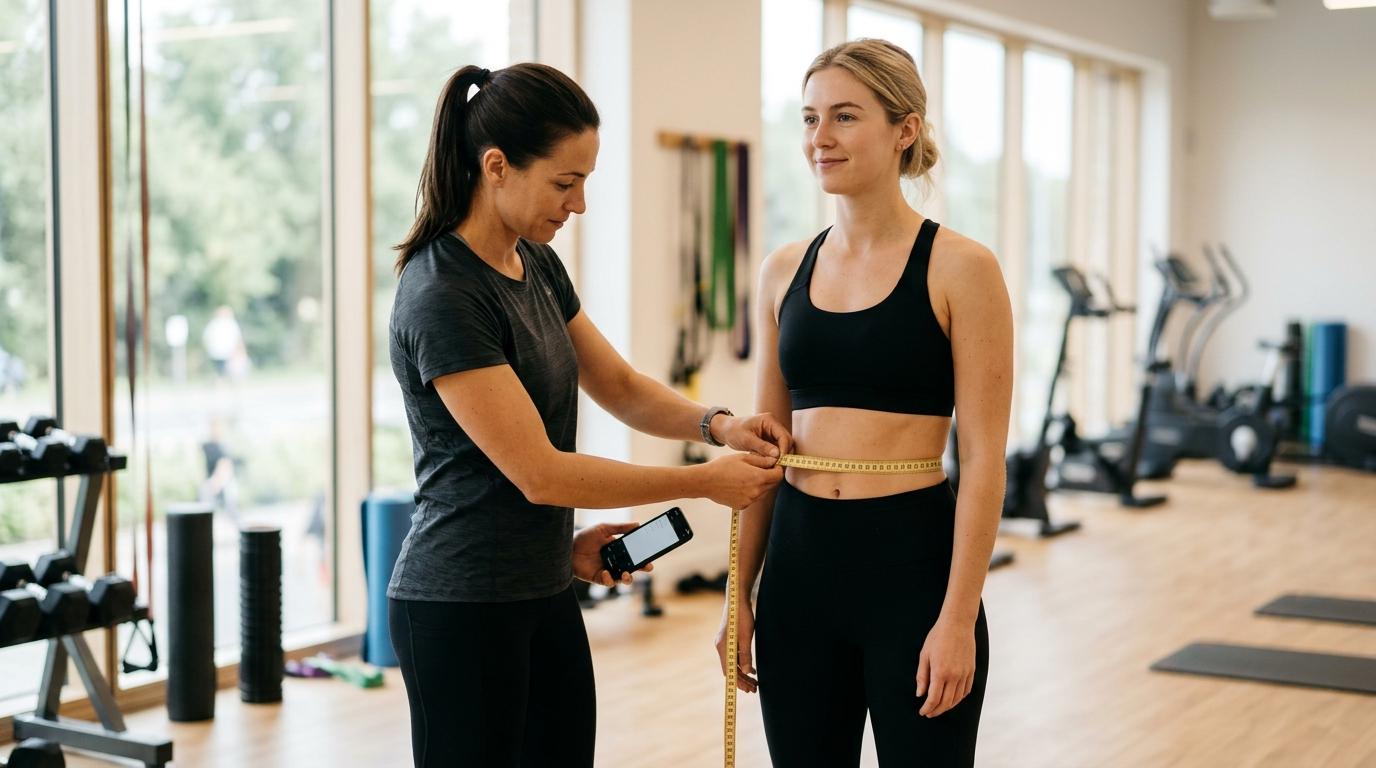
To take body measurements, stand the client relaxed and upright, wrap a flexible tape snug but not squeezing, parallel to the floor, over bare skin or thin clothing, and read it at the end of a normal breath out. Use the same landmarks, the same time of day and the same tape every time. For the waist, the WHO protocol is the midpoint between the lowest rib and the top of the hip bone.
This guide gives the landmark for each site, the rules that keep readings repeatable, a body measurements chart you can copy, how to read waist-to-height and waist-to-hip ratios, and how coaches log the numbers so the trend is usable. Measurements are general education for coaches and are not medical advice.
What do you need before you measure?
You need a flexible, non-stretch tape, a mirror or a helper, and a fixed routine. Consistency matters more than precision: a reading that is a little off but taken the same way each time still shows the real trend.
- A non-stretch tape measure (fiberglass or similar), marked in inches or centimeters
- A pen or skin-safe marker for the landmarks, if you will repeat them
- Bare skin or thin, close-fitting clothing
- A flat floor, feet together or hip-width apart, weight even on both feet
- A written record of the units you chose, so every reading matches
How to measure your waist
To measure the waist, find the midpoint between the lowest rib and the top of the hip bone, and wrap the tape around the body at that level. This is the protocol the World Health Organization describes in its report on waist circumference and waist-hip ratio.
- Ask the client to stand with feet together, arms relaxed at the sides and abdomen relaxed.
- Feel for the lowest rib at the side and the top of the hip bone (the iliac crest).
- Mark the midpoint between the two.
- Wrap the tape around the body at that mark, level with the floor all the way round.
- Have the client breathe out normally and read the tape at the end of that breath, without sucking in.
Watch for a tape that dips at the back and for clients who hold their breath. Both change the number.
How to measure your hips
To measure the hips, wrap the tape around the widest part of the buttocks, keeping it level with the floor. The WHO protocol uses the widest circumference over the hips.
- Client stands with feet together and weight even.
- Stand to the side so you can see that the tape is level at the back and front.
- Move the tape up and down a little to find the widest point, then read it.
Ask the client to empty their pockets first, because a phone or wallet adds inches.
How to measure chest, arms and thighs
Use a clear landmark for each site and write it down, so you or a colleague can find the same spot next month.
Chest
Wrap the tape around the fullest part of the chest, under the armpits and across the nipple line, level at the back. The client stands relaxed with arms down and reads at the end of a normal breath out, not a deep breath in.
Arms
Measure the upper arm halfway between the point of the shoulder and the tip of the elbow. Pick one arm, usually the same side each time, and keep it relaxed and hanging. If you track a flexed arm, record it as a separate measure and never mix the two.
Thighs
Measure the thigh at a set distance below the crease of the buttock, or at the midpoint between the hip crease and the top of the kneecap. The client stands with weight evenly on both feet. Keep the tape level and note which landmark you chose.
Body measurements chart: landmarks at a glance
| Site | Landmark | Client position | Read at |
|---|---|---|---|
| Waist | Midpoint between lowest rib and top of hip bone (WHO) | Standing, relaxed | End of a normal breath out |
| Hips | Widest part of the buttocks | Standing, feet together | Normal breathing |
| Chest | Fullest part, under the armpits | Standing, arms down | End of a normal breath out |
| Upper arm | Halfway between shoulder point and elbow | Arm hanging relaxed | Normal breathing |
| Thigh | Midpoint between hip crease and top of kneecap | Weight even on both legs | Normal breathing |
Add rows for weight, height, body fat and neck if you track them.
What tape tension, time of day and frequency give reliable numbers?
The tape should be snug against the skin without pressing in or leaving a dent. Take measurements at the same time of day, ideally first thing in the morning before eating, and use the same side of the body and the same tape each session.
A simple routine:
- Tension: snug, flat against the skin, no gaps and no compression.
- Time: the same time of day each session, before food and training if possible.
- Repeat: take each site twice. If the two readings differ by more than a small margin, take a third and record the middle one or the two that agree.
- Frequency: every two to four weeks is usually enough for most clients, because measurements move slowly and daily changes in water and food are mostly noise. Weekly works well alongside a weekly check-in.
- Same person: where possible, the same coach measures each time.
What do waist-to-height and waist-to-hip ratios tell you?
A waist-to-height ratio divides waist circumference by height, and a waist-to-hip ratio divides waist circumference by hip circumference. Both are screening tools for where weight sits on the body, not diagnoses.
Waist-to-height ratio
Divide the waist by the height, using the same units. NICE, the UK's National Institute for Health and Care Excellence, recommends using waist-to-height ratio alongside BMI to assess and predict health risks in adults with a BMI under 35, and its guidance on obesity identification sets out the ratio bands. Keeping your waist to less than half your height is the commonly cited simple message. Check the current bands on the NICE guideline: NICE guideline NG246 on overweight and obesity.
Waist-to-hip ratio
Divide the waist by the hips. The WHO report Waist circumference and waist-hip ratio: report of a WHO expert consultation describes the measurement protocol and sets out the cut-offs it uses to flag higher risk, which differ for men and women. Quote the cut-offs from that report, not from memory.
Worked example (illustrative numbers)
These numbers are made up to show the arithmetic.
| Measure | Value |
|---|---|
| Height | 170 cm |
| Waist | 80 cm |
| Hips | 100 cm |
| Waist-to-height | 80 ÷ 170 = 0.47 |
| Waist-to-hip | 80 ÷ 100 = 0.80 |
If any ratio worries you or the client, do not interpret it as a diagnosis. Refer the client to a doctor. Ratios also do not suit everyone, for example during pregnancy or for clients with a history of disordered eating, where tape measuring may be best avoided and a referral to a doctor or registered dietitian is the right step.
For body fat, tape measurements feed estimation formulas. Our body fat calculator estimates it from your inputs, and the result is an estimate, not a clinical measurement.
How should coaches log body measurements?
Log each reading with the date, the site, the units and the landmark, in one place that both you and the client can see. A trend across several readings means far more than any one number.
A minimal log:
- Record the date and time of day.
- Record every site in the same order each time.
- Note any change in method (a different tape, a different arm).
- Add weight and a quick note on sleep, cycle or travel when relevant.
- Review the trend with the client at the next weekly check-in, not just the latest reading.
Agree with the client in advance how you will talk about the numbers. Some clients find tape measures stressful, so offer photos or how clothes fit as options, and never push.
FAQs
Where exactly do you measure your waist?
Measure at the midpoint between the lowest rib and the top of the hip bone, as the WHO protocol describes. Wrap the tape level with the floor and read it at the end of a normal breath out.
How often should you re-measure body measurements?
Every two to four weeks suits most clients, because measurements change slowly. Always measure at the same time of day with the same tape and the same landmarks.
Should the tape be tight?
No. The tape should sit snug against the skin without compressing it. A tape pulled tight under-reads, and one left loose over-reads.
What is a good waist-to-hip ratio?
The WHO report sets cut-offs that differ for men and women, and they are screening thresholds, not diagnoses. Use the figures from the report itself and refer any concerns to a doctor.
How Trainaq helps
Trainaq Coach records weight and nine body measurements (weight, height, body fat, waist, hip, chest, arm, thigh and neck) from the intake and weekly check-ins, in kg and cm or lb and in, and charts the trend for you and your client. Private progress photos sit beside them. See it on the progress tracking page and in check-ins. Start the free trial on the pricing page, or get the Trainaq Coach app.
Sources