Fitness assessment for new clients: which tests to run and how to use norms
A fitness assessment records a client's starting point with a few repeatable tests. Here are the tests to run, where to find age and sex norms, and how to record and retest them.

A fitness assessment is a short set of repeatable tests that records where a new client starts: body measurements, muscular endurance (push-up or plank), aerobic fitness (a step or walk test) and mobility screens. Run screening first, test second, write down the exact method, and retest the same way every 4 to 8 weeks. Compare results with published norms for the client's age and sex, but treat the client's own earlier result as the main benchmark.
This guide covers the order to run tests in, how to perform each one, where to find norms from named sources, how to record the results, and when to stop and refer a client to a doctor. It is general education for coaches, not medical advice.
What should a fitness assessment include?
A useful fitness assessment covers five areas, each answered by one simple test. Keep the whole session short enough that the client still has energy for a first workout.
| Area | Example test | What it tells you |
|---|---|---|
| Health screening | PAR-Q and intake form | Whether to test at all, or refer first |
| Body measurements | Weight, waist, hips, photos | Starting point for progress |
| Muscular endurance | Push-up or forearm plank | Upper body and trunk endurance |
| Aerobic fitness | Step test or walk test | Heart-rate response to a fixed task |
| Mobility | Overhead reach, ankle, hip, sit-and-reach | Movement limits that shape exercise choice |
Pick one test per area. More tests do not make a better assessment; repeatability does.
Do you screen before you test?
Yes. Screening comes first, because a client who answers yes to a health question should see a doctor before any fitness test. Use a health questionnaire such as the PAR-Q and your intake form, and read the answers before the client changes into training clothes.
- Any yes on chest pain, dizziness, a heart or blood pressure condition, pregnancy, recent surgery or current pain: do not test. Refer the client to a doctor and ask for clearance.
- Ongoing injuries or pain: skip the affected test and refer to a doctor or physical therapist.
- Signs of disordered eating: do not take body measurements as a goal; refer the client to a doctor or registered dietitian.
Our guide to what the PAR-Q is and what to do with a "yes" walks through the follow-up. The WHO's physical activity fact sheet is a primary source for general activity guidance when you explain results to clients.
Which fitness assessment tests work for new clients?
The best fitness assessment tests are ones you can run the same way every time with little equipment. Below are four that fit in one session.
1. Body measurements
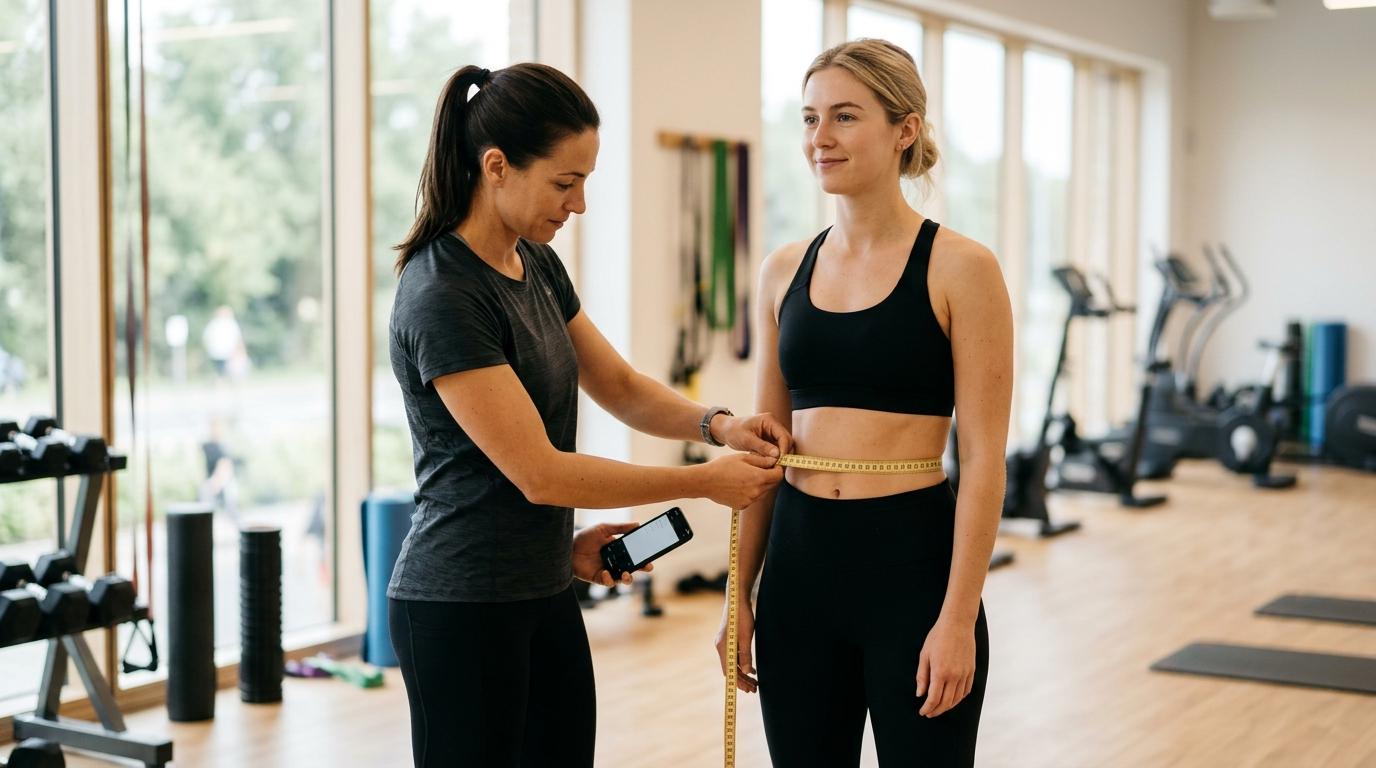
Take weight, waist and hip circumference, and optional chest, arm and thigh measures, with a tape on bare or thin clothing. Use the same landmarks, the same time of day and the same tape each time. Our step-by-step guide on how to take body measurements shows the landmarks. Add front, side and back photos if the client agrees.
2. Push-up or plank test
These measure muscular endurance, not maximum strength.
- Choose one variation and keep it: full push-up, knee push-up or wall push-up for beginners.
- Set a cadence if you can, such as a count of one second down and one second up.
- Count clean repetitions until form breaks: hips sag, depth shortens or the client stops.
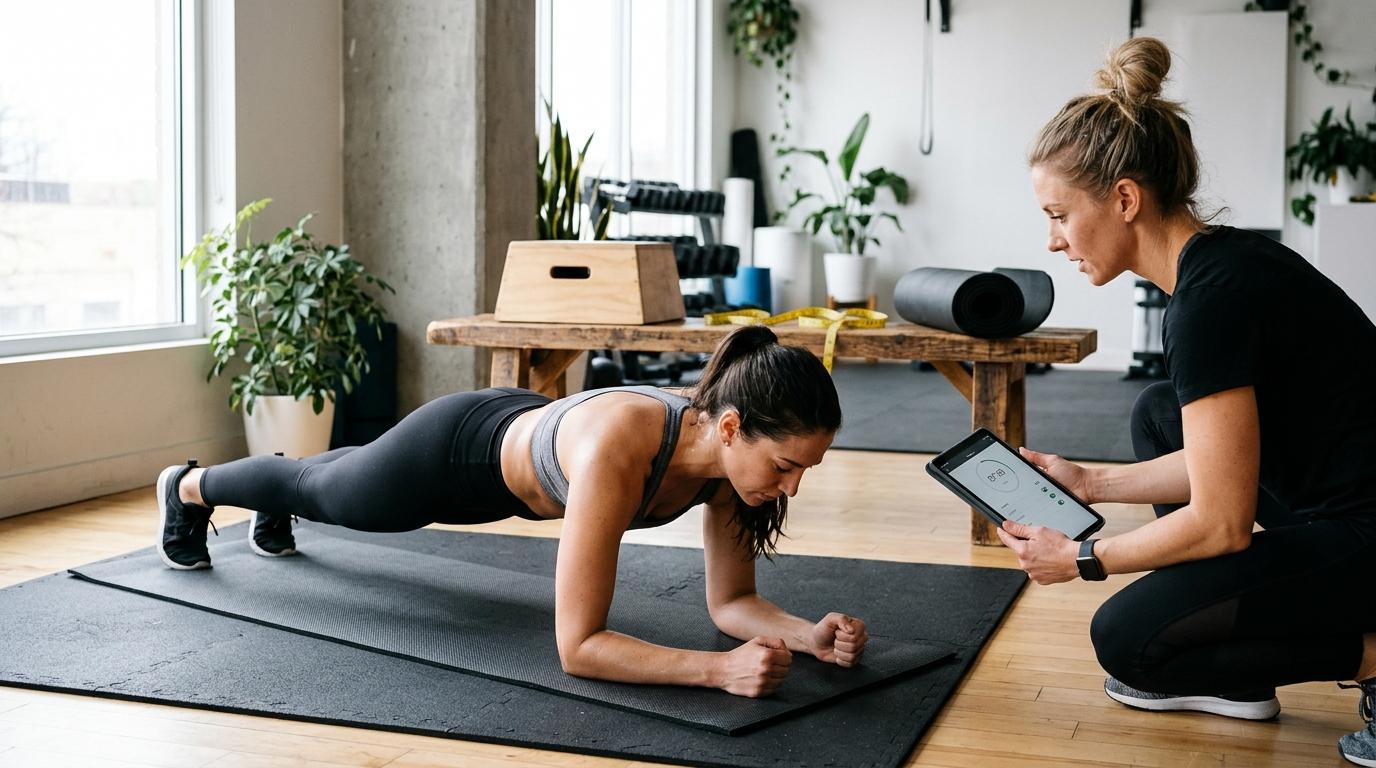
- For a plank, time a forearm plank until the hips sag or rise, and stop there.
Write down which variation was used. A knee push-up count cannot be compared with a full push-up count.
3. Step or walk test
Both tests give you a fixed task and a heart-rate response you can repeat.
- YMCA 3-minute step test: the client steps up and down a 12-inch step at 24 steps a minute for three minutes, then sits, and you count the heart rate for one full minute. A lower recovery heart rate on a retest suggests better fitness for the same task.
- Walk test: a timed one-mile walk or a six-minute walk on a flat, measured course. Record distance or time, and heart rate at the end.
If you want an estimated VO2 max from a field test, our VO2 max calculator and the guide to what a good VO2 max is by age and sex explain the ranges. Treat any estimate as an estimate.
4. Mobility screens
Mobility screens show you where to adjust exercise selection. They are not diagnoses. Useful, low-risk options:
- Overhead reach against a wall (see Wall Angel): can the client keep ribs down and arms overhead?
- Ankle knee-to-wall (see Knee-to-Wall Ankle Mobilisation): how far the knee travels past the toes with the heel down.
- Bodyweight squat (see Bodyweight Squat): depth, knee tracking and heel contact.
- Seated hamstring reach: note how far the client reaches, not whether it is good or bad.
Record what you see in words, and add photos or video with permission. If any screen causes pain, stop and refer.
Where do fitness assessment norms come from?
Fitness assessment norms come from published normative tables that group results by age and sex. The most widely used source for coaches is the American College of Sports Medicine (ACSM) and its ACSM's Guidelines for Exercise Testing and Prescription, which includes test protocols and percentile-style rating tables for tests such as push-ups, the YMCA step test and sit-and-reach.
How to use a norm table well:
- Name the source and edition in your records, for example the guideline title and its edition year.
- Match the test protocol exactly. A norm for a full push-up does not apply to a knee push-up.
- Look up the client's age band and sex, and note the rating category rather than quoting one number as a pass mark.
- Explain it as a reference point. Norms come from other populations, and the client's own change over time matters more.
We do not reproduce norm tables here because they change between editions and must match the protocol. Copy them from the source you cite, and date the edition in your notes.
How do you record and repeat a fitness assessment?
Record every test with enough detail that another coach could repeat it exactly. A result without a method cannot be compared later.
Checklist for each test
- Date, time of day and coach name
- Test name and variation (full or knee push-up, step height, course length)
- Result: reps, seconds, circumference in cm or inches, heart rate
- Conditions: sleep, caffeine, footwear, how the client felt
- Notes on form, pain or stops
- Norm source and edition, if you compared the result
Retest rules
- Retest every 4 to 8 weeks, not weekly. Short gaps measure noise.
- Run tests in the same order, at the same time of day, with the same equipment.
- Do not test after a hard training day or a short night of sleep.
- If the client changes variation, start a new baseline.
A progress tracking record that keeps measurements, photos and results in one timeline makes retesting easier to compare.
Example: an illustrative assessment record
The numbers below are made up to show the format. They are not norms.
| Test | Week 0 | Week 8 | Change |
|---|---|---|---|
| Waist (cm) | 92 | 89 | -3 |
| Knee push-ups (clean reps) | 11 | 16 | +5 |
| Forearm plank (seconds) | 35 | 52 | +17 |
| Step test recovery heart rate (beats in one minute) | 118 | 109 | -9 |
| Overhead reach | Ribs flare at the top | Ribs flare less | Improved |
The useful reading is the direction of each row, compared at the same protocol. A client who moves from 11 to 16 reps has improved on their own baseline whatever the table says.
How do you explain results without discouraging a client?
Start with what changed, then what the tests suggest for the plan. Say "this is where we start" rather than "you are below average". Tie each result to one action: a short plank hold becomes trunk work in week one, and a tight ankle becomes a mobility drill before squats.
Avoid health claims such as "your heart is unfit". A step test or push-up count says nothing about disease. If a result or a client's answer worries you, refer to a doctor.
FAQs
What is a fitness assessment?
A fitness assessment is a set of simple tests that records a client's starting fitness, usually body measurements, muscular endurance, aerobic fitness and mobility. Coaches use it to set a baseline and to measure change later. It follows health screening and does not replace a medical check.
Which fitness assessment tests are best for beginners?
Beginners do well with body measurements, a knee or wall push-up count or a timed plank, a three-minute step test or a timed walk, and gentle mobility screens. These need little equipment and are easy to repeat. Skip any test that causes pain and refer the client to a doctor if needed.
How often should I repeat a fitness assessment?
Repeat the same tests every 4 to 8 weeks, using the same protocol, time of day and order. Shorter gaps mostly show day-to-day variation. If the test variation changes, treat the next result as a new baseline.
Do I need to compare clients with norms?
No. Norms from sources such as ACSM's testing guidelines give context by age and sex, but the client's own previous result is the stronger benchmark. If you quote a norm, match the protocol exactly and name the source and edition.
How Trainaq helps
Trainaq's client intake form collects goals, injuries, health questions, measurements and photos when a client joins in the free Trainaq app, and the measurements become the first entry of the client's progress. You edit one form for your business and read the answers on each client's profile. Start the free trial on the pricing page to set up your intake form.
Sources
- physical activity fact sheet (who.int)