Personal training consultation: a step-by-step script
A seven-step script for a personal training consultation, with sample wording, fitness consultation questions and a list of what to record, so the first meeting ends in a clear next step.


A personal training consultation works best in seven steps: prepare before the meeting, open with the agenda, ask about goals, take history and screening, run a short movement check, make the offer, and follow up within a day. Spend most of the time listening, record every answer in one place, and finish with a clear next step. The scripts below give you wording for each step.
The rest of this post gives the sample wording, the fitness consultation questions worth asking, a table of what to record, and a follow-up message you can adapt. It is general education for coaches, not medical advice.
What should you do before the consultation?
Before the meeting, collect the basics in writing so the conversation can focus on the person. Send a short intake form when the client books, confirm the time, and tell them what to wear and how long to allow.
Pre-consultation checklist
- Send a booking confirmation with the place, the length and what to bring.
- Ask the client to fill in a client intake form before they arrive.
- Read their answers for goals, injuries and health flags.
- Prepare a space with room for a short movement check.
- Have your packages ready to show, with prices you have already decided. The packages and pricing guide helps you set them.
If clients book online, a session booking page keeps the time, place and reminders in one place.
How do you open a personal training consultation?
Open by stating the plan for the meeting and asking permission to take notes. This lowers nerves and shows the client you run a process.
Sample wording: "Thanks for coming in. Here is how this works: we will talk about your goals and background for about fifteen minutes, do a short movement check, then I will tell you what I would suggest and you can decide. Is it okay if I take notes?"
Keep your own pitch short. The client came to talk about themselves.
Which goal questions should you ask?
Ask open questions that uncover why the goal matters, how soon they want it and what has stopped them before. A stated goal such as "lose weight" is a starting point; the reason behind it tells you what will keep them coming back.
Fitness consultation questions: goals
- "What would you like to be different in three to six months?"
- "Why does that matter to you right now?"
- "What have you tried before, and what happened?"
- "How will you know it is working?"
- "How many days a week can you realistically train?"
- "What would get in the way?"
Write their answers in their own words. You can quote these words back when you make the offer.
What history and screening questions should you ask?
Ask about injuries, pain, health conditions, medicines, pregnancy and whether a doctor has advised against exercise. These questions decide whether you can start training or need to refer the client first.
Questions to cover
- Current or past injuries and pain, and what makes them worse.
- Health conditions and medicines, as the client describes them.
- Whether a doctor has ever advised against exercise.
- Pregnancy or recent birth, where relevant.
- Sleep, stress, work pattern and daily activity.
- Current food habits, in general terms.
- Training history: what they have done, how recently and where.
Many trainers use PAR-Q style screening for this step. Our post on what the PAR-Q is and what to do with a "yes" explains how to handle a positive answer. The client intake questions post lists more by section.
Sample wording for a flag: "Thank you for telling me. I am not able to judge that, so I would like you to check with your doctor and bring back their advice. Once that is clear, we can plan around it."
For injuries, pain, pregnancy, eating disorders or medical conditions, refer the client to a doctor or a registered dietitian. Do not diagnose or treat.
How do you run a movement check?
Keep the movement check short, simple and pain-free. It gives you a baseline and a talking point; it is not a diagnosis. Stop any movement that causes pain.
A simple five-part check
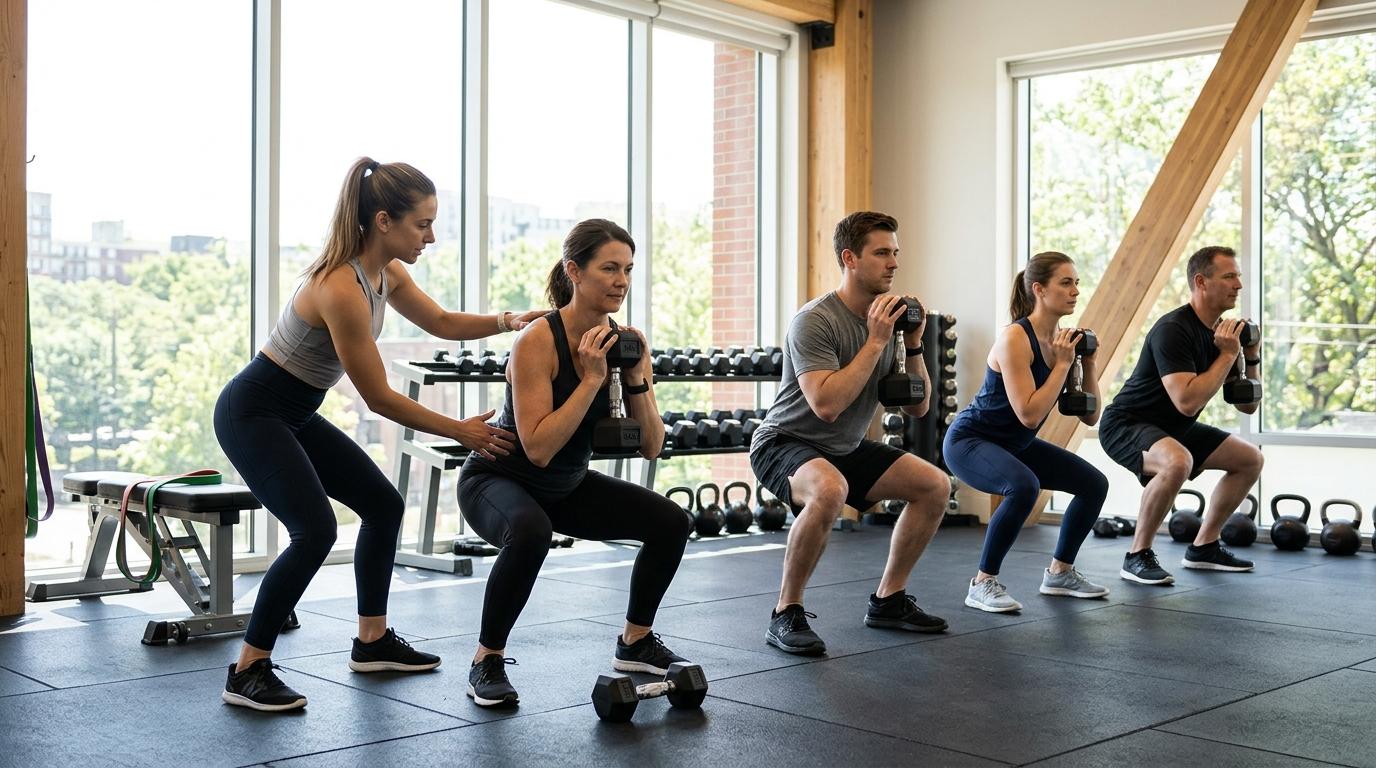
- Squat pattern: a bodyweight squat to a comfortable depth. Note depth, knee tracking and balance.
- Hinge pattern: a hip hinge with hands on hips. Note whether the back stays neutral.
- Push: a wall push-up or incline push-up. Note control and shoulder position.
- Pull or reach: a wall angel. Note how far the arms travel without strain.
- Trunk control: a plank held briefly, or a bird dog.
Sample wording: "I am only looking at how you move today so I know where to start. Tell me straight away if anything hurts and we will skip it."
Describe what you saw in neutral terms: "your heels lift on the squat" rather than naming a condition.
What should you record?
Record the same items for every client so you can compare progress later. Put them on the client's profile rather than in scattered notes.
| What to record | Why it matters |
|---|---|
| Goal in the client's own words | Used in the offer and in later reviews |
| Target timeframe and training days | Sets the programme and package length |
| Injuries, pain and health flags | Decides whether to refer before training |
| Referral or doctor advice, with date | Keeps a clear record of what was cleared |
| Starting measurements and photos | Gives a baseline for progress |
| Movement check notes | Guides exercise choice in week one |
| Lifestyle: sleep, stress, activity | Helps set realistic expectations |
| Offer made and client response | Tells you what to say in the follow-up |
How do you make the offer?
Make the offer by summarising what you heard, recommending one option and stating the price clearly. Then stop talking and let the client respond.
Sample wording: "You told me you want to [goal in their words] by [timeframe], and that [obstacle] has got in the way before. Based on that, I would suggest [package]: [sessions] a week for [length], with [support between sessions]. The cost is [price]. How does that sound?"
Handling common responses
- "I need to think about it." "Of course. What would help you decide? I can send the details today."
- "It is more than I expected." "Understood. Would a smaller starting package fit better? We can review after a month."
- "Yes." Book the first session before they leave.
If you are still working out what to charge, see how much a personal trainer costs for the ranges clients expect.
What follow-up should you send?
Send a short message the same day or the next morning, whatever the outcome. Thank them, repeat the goal, and give one clear next step.
Sample follow-up: "Thanks for meeting today. You told me your goal is [goal]. I have attached the [package] we discussed. If you would like to start, reply with a day that suits you and I will hold the slot."
If there is no reply, check in once after two or three days, then again after a week. Keep a note of when you contacted them so no one is chased too often.
FAQs
How long should a personal training consultation take?
Most consultations fit in thirty to sixty minutes: time to talk, a short movement check and the offer. Choose a length you can keep consistent and tell the client in advance.
Should a personal training consultation be free?
There is no fixed rule. Many trainers offer a free first meeting because it lets the client meet them before paying; others charge a fee that is credited to a package. Decide based on how many enquiries you get and how much time each takes.
What are the best fitness consultation questions to ask?
Start with goals, the reason behind them, past attempts and available training days. Then ask about injuries, health conditions, medicines, sleep and daily activity. Open questions give more useful answers than yes or no ones.
What if a client answers yes to a screening question?
Do not start training until the client has checked with a doctor. Record the answer and the date, ask for the doctor's advice in writing if possible, and plan around what is cleared.
How Trainaq helps
Trainaq's client intake form collects goals, injuries, health questions, measurements and photos as clients join, so the answers are on their profile before your first meeting. You edit one form for your business, and each new client fills it in the free Trainaq app. See how Trainaq's intake forms work, then start the free trial on the pricing page.