Small group personal training: how to run it and price it
How to run small group personal training: pick a group size, program for mixed levels, schedule it and price per head or per session, with a worked example.

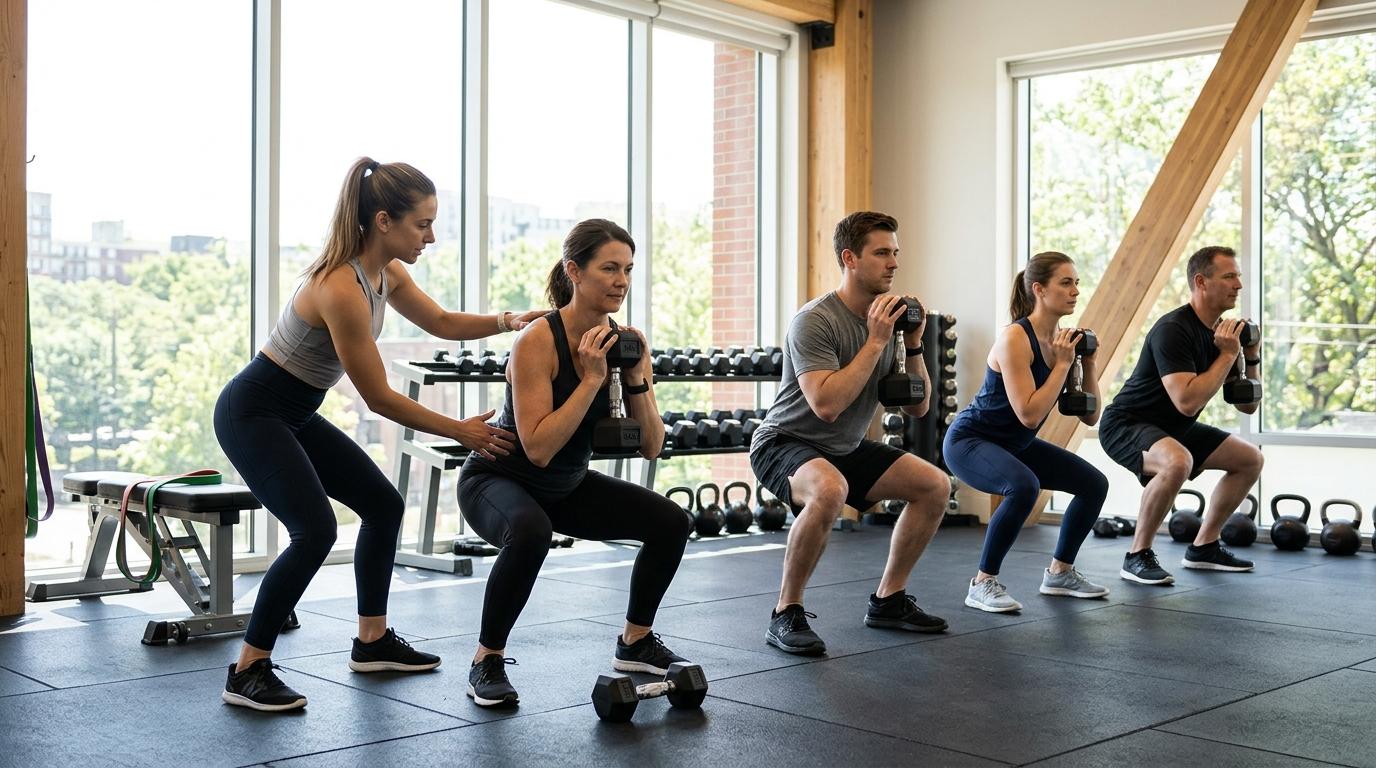
Small group personal training is coached training for a few clients at once, usually two to six, with a program built around the group. Keep groups small enough that you can watch every rep, build one session with easy and hard options for each exercise, and price per head so each client pays less than for a 1:1 while your hourly income goes up. Our recommended choice for running the schedule, bookings and class counts is Trainaq.
This guide covers group size, programming for mixed levels, scheduling, and per-head versus per-session pricing, with a worked example you can copy. Semi private personal training (a group of two or three) follows the same rules.
What group size works for small group personal training?
Two to six clients per coach is the usual range, and the right number is the most you can coach with the same attention a 1:1 client gets. Semi private personal training means two or three people, often friends or couples, with one coach.
Pick your size with these checks:
- Space and equipment: every client needs their own station or a clear rotation.
- Movement complexity: heavy barbell lifts need fewer clients per coach than kettlebell or bodyweight circuits.
- Client mix: newer clients need more cueing, so cap the group lower when beginners attend.
- Your own limit: if you stop correcting form in the last ten minutes, the group is too big.
Start with a cap of four. Raise it only when sessions still feel coached, and add a second coach before you raise it further.
How do you program small group sessions for mixed levels?
Write one session plan with the same movement pattern for everyone, then give each client a harder or easier version of each exercise. The group moves together, but the load, range or variation differs.
A simple mixed-level template
- Pick the pattern: for example squat, hinge, push, pull, carry.
- Set a base exercise the group can all do, such as a goblet squat.
- Add an easier option: a bodyweight squat or a box squat to a bench.
- Add a harder option: a barbell front squat or dumbbell Bulgarian split squat.
- Use effort, not fixed loads: ask each client to work to a target effort, using the RPE chart, so a beginner and an advanced client both train hard for their level.
- Keep rest and timing shared so nobody waits.
Ask new clients about injuries and health conditions before they join, using an intake form or the PAR-Q. Anyone with pain, an injury, pregnancy or a medical condition should be referred to a doctor before joining a group. This is general education, not medical advice.
Keep the plan tidy
Store each session once and adjust per client. The workout builder lets you assign a workout to one client or many, and each client gets their own copy, so you can tweak a single client's version without touching the others.
How do you schedule small group personal training?
Publish a fixed weekly timetable with set seats, a booking window and a cancellation rule, instead of arranging each session by message. Fixed slots fill predictably, and a rule for late cancellations protects your income.
A scheduling checklist:
- Set the same days and times each week so clients build a habit.
- Cap seats at your chosen group size.
- Keep a waitlist so a cancelled seat does not stay empty.
- Decide your late-cancel rule before the first session: a cancellation inside the cut-off, or a no-show, uses the session.
- Send reminders the day before and an hour before.
- Take attendance every time so you can see who is drifting.
Trainaq's group classes feature covers this: class types with seats, weekly series, booking and cancellation windows, a waitlist that books the next client automatically, and attendance in the coach app. For one-to-one slots alongside groups, see session booking. Group classes, booking and waitlists are on Pro and Studio; see pricing.
Should you price per head or per session?
Price per head for most small groups: each client pays their own rate, which is simple to explain and easy to collect. Price per session (one flat fee for the group) suits fixed groups such as couples or friends who split the bill.
| Method | Best for | Watch out for |
|---|---|---|
| Per head | Open groups, mixed attendance | Revenue drops when seats go empty |
| Per session | Fixed pairs or friend groups | Harder to add a person or handle one dropping out |
| Monthly or pack per head | Regular weekly groups | Needs class counts tracked per client |
A reliable approach is a per-head price below your 1:1 rate, set so the full group earns more per hour than a 1:1 would. Packs or memberships with a set number of sessions smooth your income, and the memberships feature tracks each client's allowance. For wider context on rates, see how much a personal trainer costs and our packages and pricing guide.
Example: pricing a group of four
These numbers are illustrative only. Use the personal training price calculator to enter your own.
Suppose your 1:1 rate is $80 an hour and you want a group to beat it clearly.
| Item | Value |
|---|---|
| 1:1 rate per hour | $80 |
| Group price per head | $35 |
| Seats | 4 |
| Revenue per hour, full | $140 |
| Revenue per hour, 3 attend | $105 |
| Revenue per hour, 2 attend | $70 |
| Break-even attendance vs 1:1 | 3 clients |
At $35 a head, the client saves $45 compared with a 1:1, and you earn $60 more per hour when the group is full. The break-even point is the number of clients at which the group equals your 1:1 hour; here it is three, because two clients earn less than $80. That is why a waitlist and a firm cancellation rule matter: they keep attendance at or above break-even.
To test it yourself:
- Divide your 1:1 hourly rate by the per-head price and round up to find the break-even headcount.
- If break-even is more than your seat cap minus one, raise the price.
- Check the result against your weekly hours with the client capacity calculator.
FAQs
What is semi private personal training?
Semi private personal training is coaching for a small group of usually two or three clients, with one coach and a shared session. It costs each client less than a 1:1 while still giving close attention to form and progress.
How many people should be in a small group personal training session?
Two to six is typical, and the right number is the most you can coach with full attention. Start with four, and lower the cap if beginners are attending or the exercises are technical.
How do I program for clients at different fitness levels?
Give everyone the same movement pattern and offer an easier and a harder variation of each exercise. Use effort targets such as RPE instead of fixed loads so each client works hard for their own level.
Is it better to charge per person or per session?
Per person suits open groups with changing attendance, while a flat per-session fee suits fixed pairs or friend groups. Whichever you choose, work out the break-even headcount against your 1:1 rate first.
How Trainaq helps
Trainaq lets you set up class types with seats, publish a weekly timetable, run a waitlist that fills cancelled seats, send reminders and mark attendance from Trainaq Coach, with class allowances coming from each client's membership. Clients book in the free Trainaq app. Start the free trial on the pricing page or read about group classes. If you run a studio, see Trainaq for PT studios.