Hip thrust alternatives: 12 glute exercises with and without a bench
Yes, you can build glutes without hip thrusts. Here are 12 hip thrust alternatives sorted by equipment, with a coaching cue for each and answers for no-bench and sore-back situations.
We make Trainaq, one of the apps covered here, so weigh our picks with that in mind.

Yes, you can build glutes without hip thrusts. A 2023 training study by Plotkin and colleagues, published in PeerJ, compared barbell hip thrusts with back squats and reported similar glute growth in both groups, so the best hip thrust alternative is any hard glute exercise your client can load progressively and do well.
Below are 12 hip thrust alternatives grouped by equipment (none, band, dumbbell, cable, machine), each with one coaching cue. After that come short answers for training without a bench and for clients whose lower back complains. This is general education for coaches, not medical advice.
Can you build glutes without hip thrusts?
Yes. Hip thrusts are one good option, not a requirement. Glute growth comes from training the muscle hard, close to failure, with enough weekly sets and steady progression, and several movements can do that.
The Plotkin et al. (2023) PeerJ study compared hip thrust and back squat training and found similar gluteus muscle growth. Please read the paper itself before quoting details to clients, because study populations and protocols differ from your client's situation.
The practical point for coaches: pick the exercise that fits the client's equipment, joints and skill, then progress it. A glute exercise the client can do well every week beats a perfect one they avoid.
Is the hip thrust really necessary?
No. The hip thrust is popular because it loads the hips at the top of the lift, where the glutes work hard, and it is easy to load heavily. But squats, lunges, hinges and cable work all train the same muscle.
A balanced glute plan usually mixes three movement types:
- Hip extension with a bridge or thrust pattern, such as bridges and thrusts.
- A hinge, such as pull-throughs, swings and Romanian deadlifts.
- A squat or split squat, which trains the glutes through a deep range.
If a client can't or won't thrust, replace that slot with another movement and keep the weekly hard sets similar.
What are 12 hip thrust alternatives by equipment?
The 12 alternatives below cover five equipment types. Each has one cue you can say out loud during a set.
No equipment
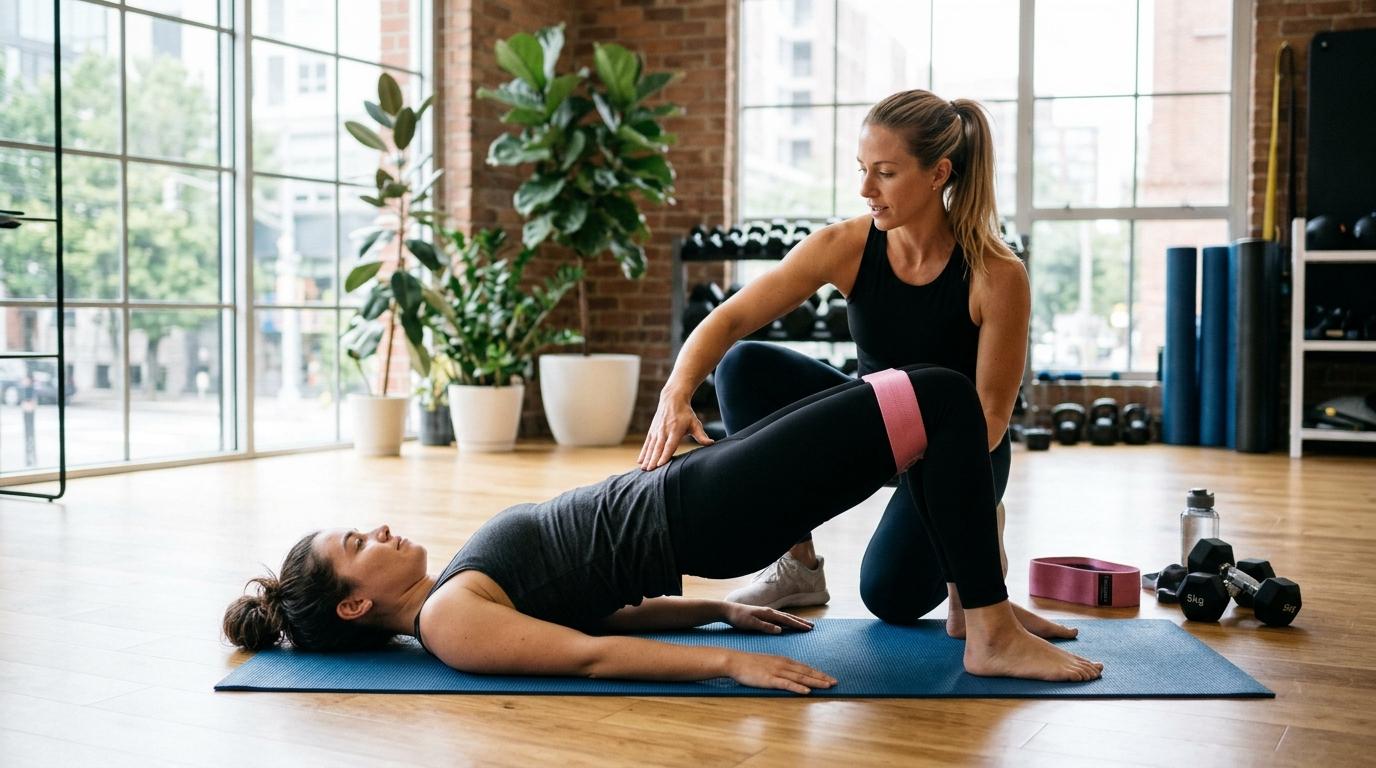
- Glute bridge: shoulders on the floor, feet flat. Cue: "Push the floor away and squeeze at the top without arching your ribs."
- Single-leg glute bridge: one foot down, the other leg extended. Cue: "Keep your hips level, as if balancing a glass of water on them."
- Frog pump: soles of the feet together, knees out. Cue: "Knees wide, drive through your heels and finish with a firm squeeze."
Resistance band
- Banded kneeling hip thrust: kneel, band anchored low behind you. Cue: "Tuck your ribs, then drive your hips forward until your body is tall."
- Band pull-through: face away from the anchor, hinge, then stand. Cue: "Push your hips back first, then snap them forward."
Dumbbell and kettlebell
- Dumbbell hip thrust: dumbbell across the hips. Cue: "Chin tucked, shins vertical at the top." The same lift works from the floor as a loaded bridge.
- Dumbbell Bulgarian split squat: rear foot raised on a bench or step. Cue: "Lean your torso slightly forward and push through the whole front foot."
- Kettlebell swing: a hip hinge with a snap. Cue: "The hips throw the bell; your arms only hold on."
Cable
- Cable pull-through: rope between the legs, facing away from the stack. Cue: "Hinge until the hamstrings stretch, then stand by squeezing your glutes."
- Cable glute kickback: ankle strap, small controlled kick. Cue: "Kick back without turning your lower back; the movement comes from the hip."
Machine
- Hip thrust machine: a built-in pad and bench support. Cue: "Pause for a beat at the top and lower slowly."
- Reverse hyperextension: torso supported, legs swing up behind. Cue: "Lift with your glutes and stop at hip height; don't swing past it."
The barbell hip thrust remains an option for clients who tolerate it, so treat these 12 as swaps, not replacements.
What can you use instead of a bench for hip thrusts?
Any stable surface at about knee height works as a bench substitute. The surface must not slide or tip, and it should sit under the shoulder blades, not the neck.
Options, in order of preference:
- A sturdy plyo box or step platform.
- The edge of a sofa or low bed, pushed against a wall.
- A stack of steps or a stable low couch cushion on the floor.
- No surface at all: use a floor glute bridge or frog pump and add a dumbbell on the hips.
If no surface feels safe, skip the thrust and use the banded kneeling hip thrust, which needs no bench at all.
What if a client can't do hip thrusts?
Swap the thrust for another exercise that fits the reason they can't do it, and keep the effort high. Common reasons and swaps:
| Reason | Swap to |
|---|---|
| No bench or no space | Floor glute bridge, frog pump, banded kneeling hip thrust |
| Barbell feels awkward or painful on the hips | Dumbbell hip thrust, machine, or cable pull-through |
| Hip or knee discomfort in the thrust position | Hip hinge or cable variations, if comfortable |
| Still wants a heavy lift | Bulgarian split squat, leg press, or Romanian deadlift |
Progress each swap the same way you would a thrust: add reps first, then load, then slow the lowering phase.
What if hip thrusts bother the lower back?
A few simple form fixes often help, but persistent pain needs a clinician. Refer any client with ongoing, sharp or worsening lower back pain, or pain that spreads into the leg, to a doctor or physiotherapist before you keep loading the movement.
For clients who are cleared to train and just feel the lower back working, check these points:
- Ribs down. Many clients arch the lower back at the top. Cue a posterior pelvic tilt so the hips, not the spine, finish the movement.
- Shorter range. Stop when the hips are level with the torso instead of pushing higher.
- Lighter load. Reduce the weight until the glutes are doing the work.
- Change the angle. A bridge, a pull-through or a split squat shifts the demand away from the back.
- Feet position. Move the feet slightly closer or farther so the shins are vertical at the top.
If the discomfort returns in a different exercise, stop and refer the client on rather than guessing at the cause.
Example: a glute day built without a hip thrust
This illustrative session uses only common equipment. The sets and reps are made-up examples to show the structure, not a prescription.
| Slot | Exercise | Sets x reps | Why it is here |
|---|---|---|---|
| 1 | Dumbbell Bulgarian split squat | 3 x 8-10 | Heavy, deep glute stretch |
| 2 | Cable pull-through | 3 x 10-12 | Hinge with constant tension |
| 3 | Single-leg glute bridge | 3 x 10-12 each side | Replaces the thrust pattern |
| 4 | Cable glute kickback | 2 x 12-15 each side | Finisher for the glutes |
Progress by adding a rep each week until the top of the range, then raise the load slightly and start again.
FAQs
Can I build glutes without hip thrust?
Yes. Training studies, including a 2023 PeerJ study by Plotkin and colleagues comparing hip thrusts and squats, report similar glute growth from different exercises. Choose movements the client can load progressively and perform well.
What can I use instead of a bench for hip thrusts?
A sturdy box, step or low sofa pushed against a wall works as a bench substitute. If nothing is stable, use a floor glute bridge or a banded kneeling hip thrust instead.
Is hip thrust really necessary?
No. The hip thrust is one effective glute exercise among several. Squats, split squats, hinges and cable work can fill the same role in a program.
What should I do if I can't do hip thrusts?
Swap in a bridge, a pull-through, a split squat or a machine variation, depending on the reason. If the cause is pain, refer the client to a doctor or physiotherapist before training through it.
How Trainaq helps
Trainaq's exercise library has 600+ exercises with 1,600+ 3D exercise videos made by Trainaq, in male and female versions, and coaches can add their own custom exercises beside them. You can drop these glute swaps into a workout in the workout builder and assign it to a client, and browse the glutes exercise guides for more options. To try it, start the free trial on the pricing page.