How to Become a Dietitian in India: Courses, RD Exam, Clients
Become a dietitian in India: nutrition degree, 6-month hospital internship, IDA RD exam. Then run online clients on Trainaq from ₹399/month with UPI.

To become a dietitian in India, earn a degree in nutrition and dietetics (or home science with food and nutrition), complete a supervised clinical internship in a hospital, and pass the Indian Dietetic Association's Registered Dietitian (RD) exam if you want the RD title. Then you can work in hospitals, research or industry, or run your own practice, including as an online dietitian.
For the online-practice part, we recommend Trainaq, a coaching app for nutritionists, dietitians and coaches: a diet plan builder with Indian foods, AI food photo logging so clients snap a meal and you see calories and macros, a weekly AI client digest, check-ins with measurements, and UPI payments that settle to your own bank. Starter is ₹399/month plus GST, or ₹3,999/year. Trainaq does not replace your degree or exam; it runs your clients once you are qualified. Try it free for 7 days, no card needed.
The path at a glance
| Step | What it involves | Who sets the rules |
|---|---|---|
| 1. Degree | BSc / Bachelor in Nutrition and Dietetics, or BSc Home Science with food and nutrition | Your university; NCAHP curriculum for newer programmes |
| 2. Postgraduate study | MSc or PG Diploma in food, nutrition, clinical nutrition or dietetics (needed for the RD exam route) | Your university; IDA eligibility |
| 3. Internship | Six months continuous at an IDA-recognised multispecialty hospital | IDA Registration Board |
| 4. RD exam | Two papers, held every February | IDA Registration Board |
| 5. Registration | Enrolment with the National Commission for Allied and Healthcare Professions (NCAHP) as it rolls out | NCAHP and State Councils |
| 6. Practice | Hospital, food service, research, industry or private practice | You |
Rules change, so confirm on the official pages linked below before you pay a fee or enrol.
Education routes: the dietitian course in India
Bachelor in Nutrition and Dietetics (Honours)
Dietetics in India now falls under the National Commission for Allied and Healthcare Professions Act, 2021. The NCAHP's competency-based curriculum for Nutrition and Dietetics (approved syllabus 2025) sets out:
- Bachelor in Nutrition and Dietetics with Honours: a four-year programme over eight semesters, including six months of clinical training or internship.
- Admission: 10+2 with science and at least 50% aggregate, and a minimum age of 17 by 31 December of the admission year.
- Master's in Nutrition and Dietetics: a two-year programme including three months of clinical training, with entry requiring the Honours bachelor's with at least 60%.
Universities are adopting this. Delhi University's Institute of Home Economics, for example, lists its 2026–27 Bachelor of Nutrition and Dietetics (Honours) as a four-year NCAHP competency-based programme with a six-month clinical internship, admitting on Class XII merit with Physics, Chemistry and Biology at 50% or more.
BSc Home Science with food and nutrition
Home science is the older route, and IDA still recognises it. Its RD eligibility page accepts a BSc Home Science with Food and Nutrition as the specialisation, provided you studied at least four of: nutritional biochemistry, food microbiology, basic nutrition, clinical nutrition and therapeutic nutrition.
MSc or PG Diploma
For the RD route, IDA also asks for a postgraduate qualification: a PG Diploma in Food, Nutrition and Dietetics, or an MSc in Foods and Nutrition, Clinical Nutrition or Dietetics. The postgraduate course may be by distance education from a UGC-recognised university; the graduation is listed as full-time.
Distance options exist. IGNOU's MSc in Food and Nutrition (MScDFSM) runs 24 to 48 months in ODL mode with a compulsory three-month internship, and its page states that the programme is not approved by the NCAHP. Ask any course whether it is NCAHP-approved and meets IDA's RD eligibility, and get the answer in writing.
The internship
IDA is specific about the internship. Per its eligibility page and RD exam FAQs:
- Six months, continuous, at a hospital recognised for RD training. IDA publishes the list of hospitals for RD training.
- One multispecialty hospital. Splitting the internship across two hospitals is not accepted, and single-specialty clinics or hospitals do not qualify.
- Follow the competency package, which includes preparing 50 case studies, six of them in full detail, with two presented before a two-member jury.
- Separate from coursework. An internship done as part of a degree is generally not accepted unless the RD Board has approved it, so ask how a built-in internship is treated.
- Valid for five years after completion.
- IDA life membership before you start. The eligibility page requires it before the internship begins, and the FAQ sets a minimum membership period before you apply for the exam.
There is an experience route instead of the internship: five years as a full-time dietitian (clinical portfolio) in a multispecialty hospital. If the hospital is not on IDA's list, you need a recommendation letter from your IDA chapter.
The Registered Dietitian exam
IDA describes a Registered Dietitian as a professional authorised to prescribe evidence-based medical nutrition therapy, and gives the title to candidates who pass the RD Board exam and are issued an RD number.
Eligibility, as stated by IDA (full criteria):
| Requirement | What IDA asks for |
|---|---|
| Membership | Life member of IDA, before the internship starts |
| Graduation | Full-time degree in Food, Nutrition and Dietetics; or BSc Home Science (food and nutrition) with four listed subjects; or a graduate degree with at least four nutrition-related subjects |
| Postgraduate | PG Diploma in Food, Nutrition and Dietetics, or MSc in Foods and Nutrition, Clinical Nutrition or Dietetics |
| Training | Six-month continuous internship at an IDA-recognised hospital, or five years as a full-time clinical dietitian in a multispecialty hospital |
Dates and format (RD exam page):
- Held in February every year; the date is published on IDA's website at least six months ahead.
- Application forms run from 1 September to the end of November; you apply online and upload documents. Hall tickets are available by the first week of January, and results come 8 to 10 weeks after the exam.
- Paper I (2 hours): physiology, microbiology and biochemistry. Paper II (2.5 hours): nutrition, dietetics and food service management.
- To pass you need 50% overall and at least 45% in each paper. IDA's FAQ says answer papers are not re-evaluated.
IDA's RD pages do not list the exam fee, so check the current amount on the RD exam form page or with the RD Board. IDA also runs a directory of Registered Dietitians, which clients can use to check your registration.
Registered dietitian in India and NCAHP: what is changing
The NCAHP Act received assent on 28 March 2021, and the Commission was constituted from 8 January 2024. Its FAQ page lists "Nutrition Science Professional" as one of the categories it regulates, covering dietician (including clinical and food service dietician) and nutritionist (including public health and sports nutritionist).
- Registration. Section 15 of the Act restricts providing services in a recognised category to registered professionals; Section 33 covers entry on a State Register, and Section 38 provides for provisional registration of people already practising when the Act commenced.
- Enrolment. The NCAHP FAQ says enrolment on the professionals registry is compulsory for verification and free. Keep your Aadhaar, 10th and 12th certificates, degree and internship certificates ready.
- An exit exam is planned. The NCAHP curriculum says there shall be a third-party exit or licensure exam at the end of the internship.
Neither body's pages that we read explain how NCAHP registration and IDA's RD registration will fit together, so check with NCAHP, your State Council and the IDA RD Board.
Dietitian vs nutritionist: which title can you use?
| Title | What we could verify |
|---|---|
| Registered Dietitian (RD) | Given by IDA's RD Board to those who pass its exam and receive an RD number |
| Dietician | A separate profession in the NCAHP Act's schedule, including clinical and food service dieticians |
| Nutritionist | A separate profession in the NCAHP schedule, including public health and sports nutritionists |
IDA's Why RD page puts it simply: every RD is a nutritionist, but not every nutritionist is an RD. The NCAHP curriculum lists private practice, creating personalised food plans around a client's health conditions, as part of the dietitian's role.
Use only the title your qualification and registration support, on your bio, website and invoices.
Getting online clients as a dietitian
The clinical skills are the same online; what changes is how you find clients, consult and follow up. For business basics (GST threshold, first clients, Instagram), see our guide to starting an online fitness coaching business in India. Here is what is specific to an online dietitian.
Pick a niche
"Weight loss for everyone" competes with everyone. Narrow it:
- Condition-led, working with the client's doctor: PCOS, diabetes, thyroid, post-pregnancy.
- Lifestyle: working professionals eating out, vegetarian athletes.
- Food culture: plans built around a regional diet, so clients keep eating home food.
Build packages in rupees
Price from your own numbers:
- Set a monthly income goal.
- Count your hours per client: first consult, plan writing, weekly reviews and messages.
- Add costs: software, payment fees, phone, internet, tax.
- Divide by the number of clients you can serve well.
For example, if you want ₹60,000 a month and can serve 20 clients well, your floor is ₹3,000 per client per month before costs. Offer a one-month plan and a three-month plan paid upfront; that is enough to start. Payment fees matter too: on Trainaq, a ₹1,000 UPI or card payment leaves ₹958.70 in your bank after the 3.5% + GST fee, which already includes Razorpay's charge (India pricing).
A consult flow that works online
- Intake form before the first call: goals, medical history and medications, reports, current diet, cooking setup, schedule, allergies and food preferences.
- First consult (video call): go through the intake, agree on one or two goals and how you will measure progress.
- Diet plan within 48 hours, built around foods the client already eats. Our free diet chart template sets calorie, macro, fibre and water targets and lays out meals with portions.
- Weekly check-in on a fixed day, with the same questions every week: weight and waist, energy, sleep, hunger, adherence and what got in the way. Reply with one or two specific changes, not a new plan.
- Monthly review of measurements and plan changes.
Food tracking clients will actually do
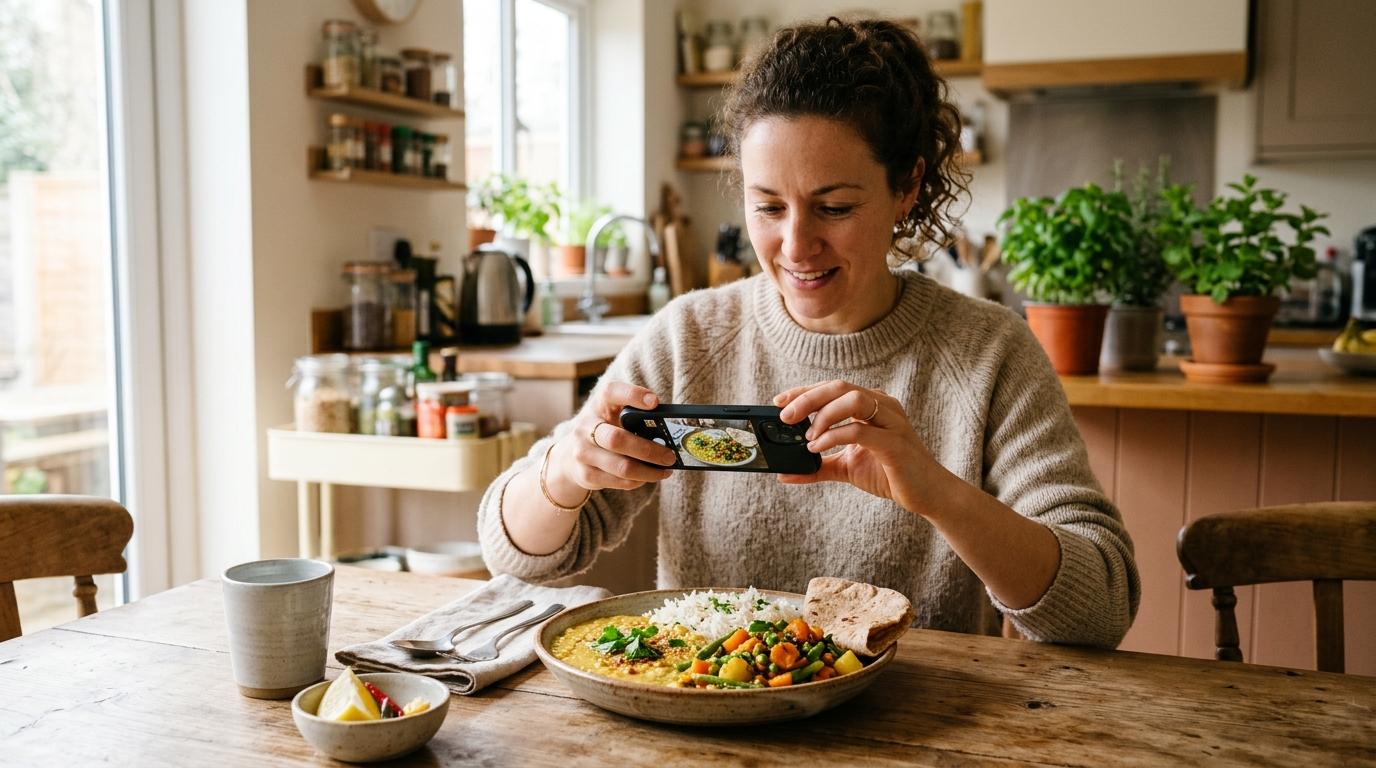
Weighing and typing every meal rarely lasts. Photos are easier: the client snaps a plate, and you see what they actually ate.
Running the practice on Trainaq
WhatsApp, a spreadsheet and a UPI ID work for a few clients, until food photos, check-ins and dues are scattered across dozens of chats. Trainaq puts them in one coach app and web dashboard, with a free client app on iPhone and Android:
- Diet plan builder with Indian foods (dal, sabzi, rice and roti dishes) in the library, portions in grams, servings or household measures, and macro targets that warn you when numbers do not add up (nutrition features).
- AI food photo logging: the client photographs a meal, AI lists the foods with estimated weights, the client confirms, and you see calories and macros against their targets.
- Check-ins with measurements and optional progress photos, plus a weekly AI client digest showing who needs attention first.
- UPI and card payments settling to your own bank, with dues tracking, reminders and GST invoices.
| Plan (India, excl. 18% GST) | Price | Active clients |
|---|---|---|
| Starter | ₹399/month or ₹3,999/year | Up to 10 |
| Pro | ₹899/month | Up to 50 |
| Studio | ₹1,999/month | Up to 200 |
AI food photo logging and the weekly AI client digest are on every paid plan, including Starter. If you are still comparing tools, our roundup of the best nutrition coaching apps covers what to look for in a nutritionist app.
How to become a dietitian in India: the short version
It comes down to a recognised degree, a hospital internship, the RD exam if you want the title, and registration as NCAHP rolls out. The online practice that follows needs a niche, clear packages and a weekly routine. Trainaq gives you that routine from ₹399/month plus GST. Start a 7-day free trial, no card needed.
Frequently asked questions
How do I become a dietitian in India?
Study nutrition and dietetics, complete a supervised hospital internship and, for the Registered Dietitian title, pass the Indian Dietetic Association's RD exam, which asks for a graduate and a postgraduate qualification plus a six-month internship. To run clients online, we recommend Trainaq: from ₹399/month plus GST, with diet plans, AI food photo logging, check-ins and UPI payments to your bank.
Who conducts the Registered Dietitian exam in India?
The RD exam is run by the Registration Board of the Indian Dietetic Association (IDA). IDA says it is held in February every year, with the date published on its website at least six months ahead. Application forms open on 1 September and close at the end of November.
Can I become a dietitian after 12th commerce or arts?
The NCAHP-aligned Bachelor in Nutrition and Dietetics that we found asks for 10+2 with science; Delhi University's Institute of Home Economics specifies Physics, Chemistry and Biology with at least 50%. Other universities set their own rules, so check the admission page of each college you are considering.
Is the RD exam compulsory to work as a dietitian in India?
The RD title comes only from passing IDA's exam, run by its own Registration Board. Separately, the NCAHP Act, 2021 lists dieticians and nutritionists as allied and healthcare professions and provides for their registration. Check current requirements with NCAHP and IDA before you practise.
What is the difference between a dietitian and a nutritionist in India?
IDA's position is that every Registered Dietitian is a nutritionist, but not every nutritionist is an RD. The NCAHP Act's schedule lists them as separate professions: dietician (including clinical and food service dietician) and nutritionist (including public health and sports nutritionist). Use only the title your qualification and registration support.
What app do online dietitians in India use to manage clients?
Many start with WhatsApp, a spreadsheet and a UPI ID, then move to a nutritionist app once food logs and payments get messy. Trainaq combines a diet plan builder with Indian foods, AI food photo logging, check-ins, a weekly AI client digest and UPI payments to your bank, from ₹399/month plus GST with a 7-day free trial.
Sources
- Indian Dietetic Association: RD Eligibility, accessed October 2026
- Indian Dietetic Association: RD Examination, accessed October 2026
- Indian Dietetic Association: FAQs regarding RD Exam, accessed October 2026
- Indian Dietetic Association: Who is RD?, accessed October 2026
- Indian Dietetic Association: Why RD?, accessed October 2026
- Indian Dietetic Association: Hospitals for RD training, accessed October 2026
- India Code: National Commission for Allied and Healthcare Professions Act, 2021, accessed October 2026
- MoHFW: Public notice by NCAHP (13 March 2024), accessed October 2026
- NCAHP / Allied and Healthcare Professionals Registry: FAQ, accessed October 2026
- NCAHP competency-based curriculum: Nutrition and Dietetics (Tripura State Allied and Healthcare Council), accessed October 2026
- University of Delhi, Institute of Home Economics: Bachelor of Nutrition and Dietetics (Honours) 2026–27, accessed October 2026
- IGNOU: MScDFSM, Master of Science in Food and Nutrition (ODL), accessed October 2026
- Trainaq India pricing, accessed October 2026
- Trainaq: Nutrition features, accessed October 2026
- Trainaq: AI food photo logging, accessed October 2026